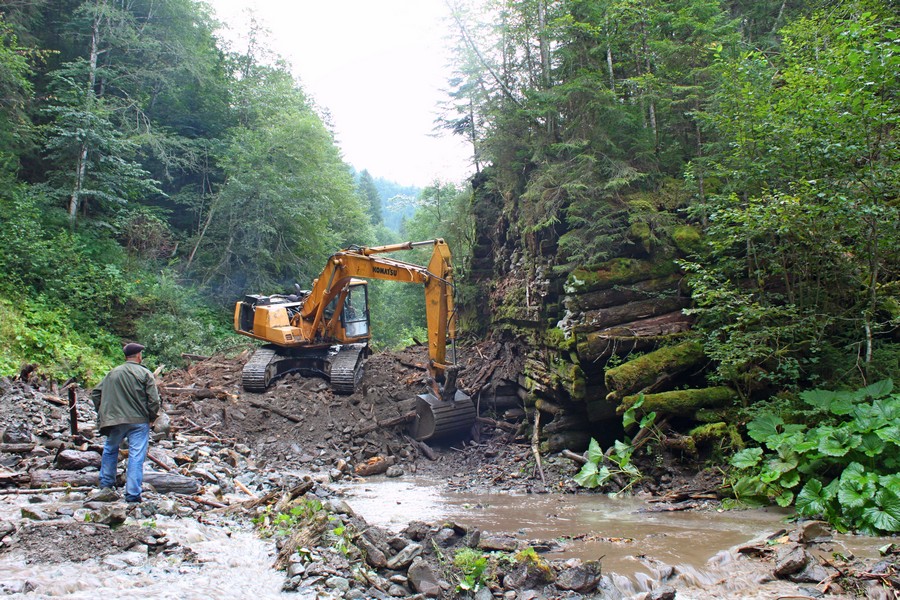
The dams planned for demolition located on the territory of the KBZ (on the Kvasny, Bohdan and Bely streams) do not perform any economic role today.
Two dams (on the Kvasny and Bohdan streams) are the remains of dams built during the Austro-Hungarian period to intensively export Carpathian forest. Today, they are a source of the danger of man-made disasters and economic losses, because they divert riverbeds towards the road, destroying the transport infrastructure.
The third dam (on the White stream) is an embankment on the bank that creates the effect of a canalized river. Thus, after the floods in 1998, they tried to save the remnants of the surviving roads from erosion.
Demolition of these three dams will make it possible to completely free the upper reaches of the Tisza from artificial obstacles.
“The Free River is a model that provides an opportunity to preserve biodiversity, tourist and, in case of emergency, transport infrastructure, improve water quality, support the economic activity of shepherds in the meadows, access of tourists to the natural values of the biosphere reserve, as well as reduce erosion and flash floods on the rivers – says the head of the NGO “Danube-Carpathian Program”, Candidate of Biological Sciences Bohdan Prots.
Until recently, dams were considered an absolute boon. They were built for field irrigation, flood control, domestic and industrial water supply, energy generation, etc. But these benefits come at a price, and often the price is too high and outweighs the benefits.
– clean water,
– fish,
– support of biodiversity,
– safety for infrastructure and settlements downstream,
– the natural appearance of the shores, which attracts tourists, etc
all these natural benefits have their value, which is often forgotten when designing dams.
Today, approaches are changing, so the world has begun an era of re-evaluating the impact of dams and restoring free-flowing rivers.
In Europe, over the past year alone, half a thousand artificial obstacles on watercourses have been demolished. This is done in order to restore the migration of fish, to restore the natural flow of the river, and also to avoid possible man-made disasters, because artificial obstacles to the riverbed are always associated with the risk of a breakthrough.